
How to Label AI-Generated Content in the EU: Article 50 & the New EU Code of Practice (2026)

2026 Update
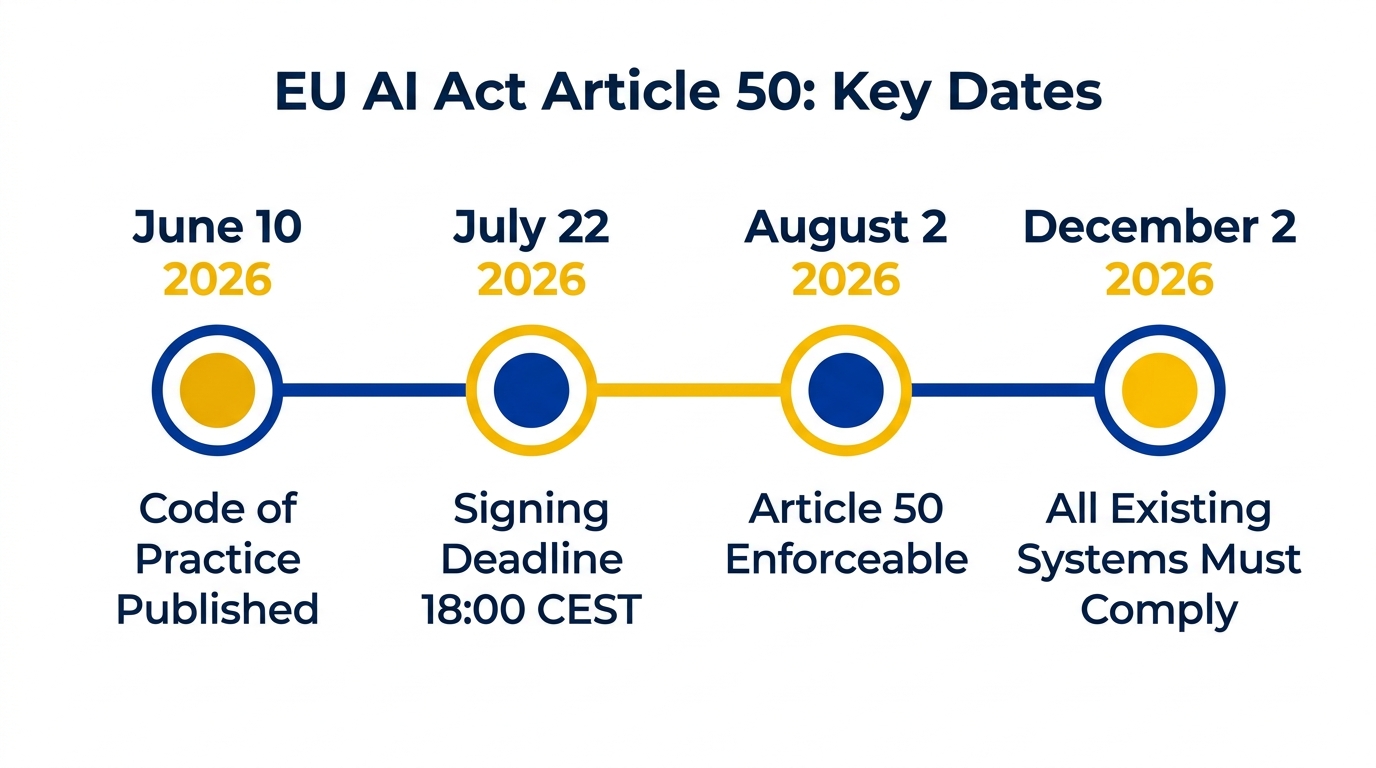
The European Commission published the Code of Practice on Transparency of AI-Generated Content on June 10, 2026. Article 50 obligations take effect August 2, 2026. The signing deadline for the initial signatories list is July 22, 2026. This post has been updated to cover everything you need to act now.
Feeling a bit lost in the new landscape of AI regulations? You're not alone. With the EU AI Act's transparency rules now imminent, understanding what's required for AI-generated content is crucial for anyone operating in Europe. Let's break down Article 50 and the brand-new Code of Practice that tells you exactly how to comply.
The Gist of Article 50: Why Transparency Matters
Article 50 is all about making sure people know when they're interacting with AI. The goal is simple: prevent deception and build trust. Think of it as a clear label on a food product; it tells you what's inside. In this case, the "product" is content or an experience created by AI.
The rules are fairly straightforward:
- You must inform users clearly and distinguishably that they're dealing with AI, right from the very first moment.
- The disclosure should be easy to see and understand. No hidden fine print.
- The most important rule applies to what the Act calls "deepfakes", those incredibly realistic, but fake, images, videos, or audio. These must always be clearly labeled.
- There's an exception for artistic or satirical works, as long as the AI involvement is obvious and a label wouldn't ruin the creative intent.
In a nutshell, Article 50 wants to avoid situations where someone might mistake a machine for a human, or believe something AI-generated is real and unedited.
The EU Code of Practice: The Missing Implementation Layer
Article 50 tells you what you must do — but not how. That gap is exactly what the Code of Practice on Transparency of AI-Generated Content fills. Published on June 10, 2026, after a multi-stakeholder process involving over 187 participants from industry, academia, civil society, and EU Member States, it is the practical playbook for Article 50 compliance.
The Code is voluntary, but signing it gives you structured, legally recognised evidence of compliance across all EU Member States — significantly reducing your administrative burden when authorities come calling.
Two Sections, Two Roles
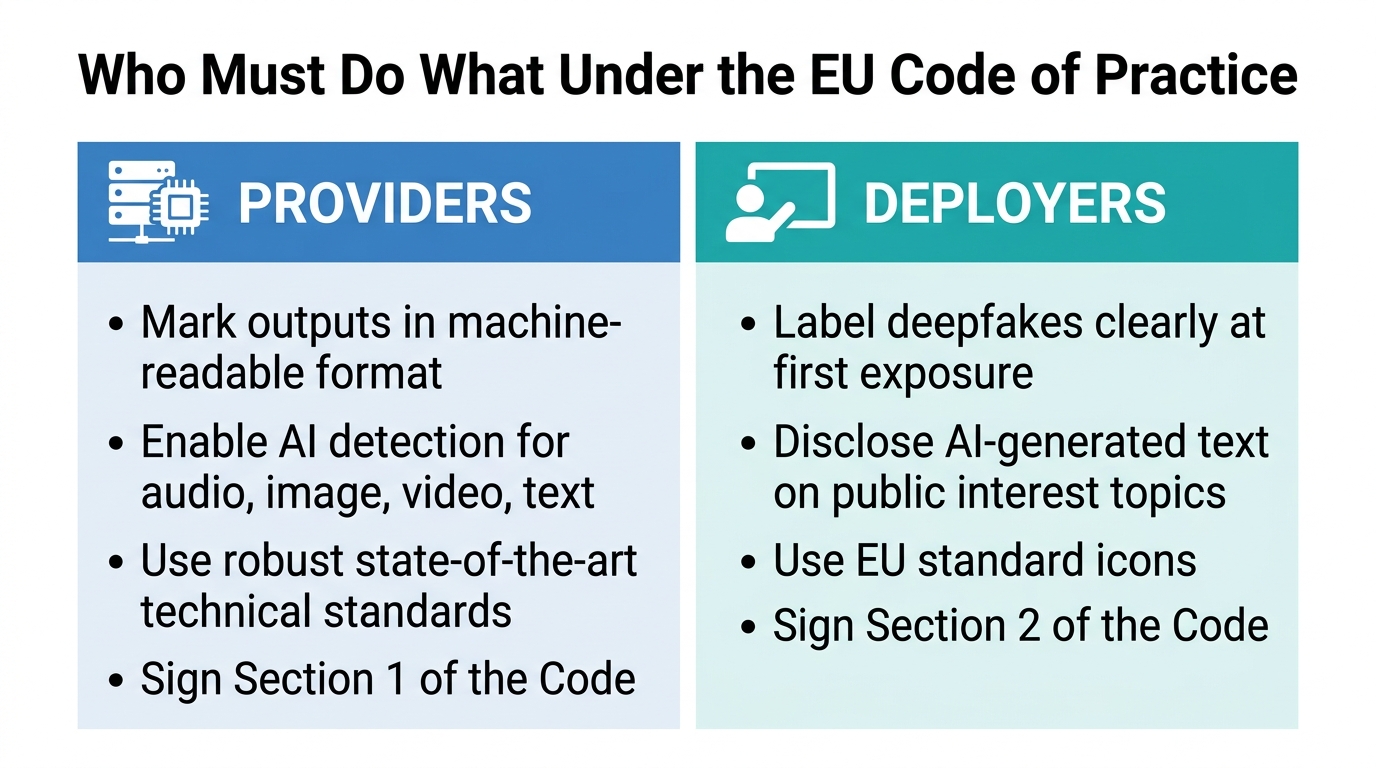
The Code is split to reflect the two actors in the AI content chain:
- Section 1 — Providers: If you build or distribute a generative AI system, you must mark system outputs (audio, image, video, text) in machine-readable formats so they can be detected as AI-generated. Technical solutions must be robust and aligned with state-of-the-art standards.
- Section 2 — Deployers: If you use a generative AI system to produce content for an audience, you must label deepfakes and AI-generated text on matters of public interest — unless a human editor has exercised genuine editorial oversight.
If your organisation acts as both provider and deployer, you must sign both sections.
The Three EU Icons for AI-Generated Content
The Commission has published three standardised EU icons for labelling AI-generated content, available as free SVG and PNG downloads in four colour variants (black, white, and 50% transparency versions of each). Using these icons is not mandatory, but they give your audience an instantly recognisable, pan-European signal.

Basic Icon
Use when: AI was involved in creating a deepfake (image, audio, video) or a published text — but you don't need to specify the degree of involvement.

Fully AI-Generated Icon
Use when: The entire content was created by AI with no human-created source material beyond prompting — e.g. a fully synthetic deepfake video, AI-generated news summary, or AI-composed audio.

Partially AI-Modified Icon
Use when: Human-made content was altered by AI into a deepfake or public-interest text — e.g. a face-swapped photograph or an AI-retouched product image.
All three icons must be clearly perceivable at the time of first exposure. Embed them directly in the content where possible; if that's not feasible (e.g. a live stream), UI overlays are acceptable. Always add alt text and ARIA labels for accessibility. Critically, the Commission is explicit: "The use of these icons does not establish legal compliance by itself." They must accompany a plain-language disclosure.
Should You Sign the Code of Practice?
Signing is voluntary — not signing does not mean non-compliance. But non-signatories must prove compliance through alternative means and may face more scrutiny from national authorities. Here is a quick decision guide:
- You should sign Section 1 if you provide or distribute a generative AI model that produces audio, image, video, or text outputs consumed in the EU.
- You should sign Section 2 if you deploy a generative AI system to produce content for a public audience in the EU, particularly on matters of public interest.
- You can sign both sections independently — technology providers who only supply marking and detection tools can sign Section 1 alone.
How to sign
Download the signature form (DOCX) from the Commission's signing page, have a senior executive with binding authority sign it, and email it to CNECT-AIOFFICE-CODE-OF-PRACTICE-TRANSPARENCY@ec.europa.eu by July 22, 2026 at 18:00 CEST to appear on the initial signatories list. Signing after this date remains possible at any time.
What This Means for Your Content
Let's look at some common scenarios and how Article 50's rules apply.
1. Chatbots
The lowdown: You're required to let users know they're talking to a bot, not a person. It's about setting the right expectation from the start.
How to comply: This one's simple. Just add a clear banner or message at the top of the chat window before the conversation even starts. Something like, "Hi there! I'm an AI assistant designed to help you." is perfect. The key is to be upfront and transparent.
2. AI-Generated Content on a Company Website
The lowdown: If you're using AI to create images, videos, or text that could be mistaken for human-made content, you need to label it. For example, if you use AI to create a hyper-realistic photo of a person for a blog post, it must be labeled.
How to comply:
- For images and videos, a small, clear watermark in the corner or a line of text directly below the content, such as "This image was created with AI," is a great approach.
- For text, if a piece is about a topic of public interest and was written by AI without significant human review, it needs to be labeled. However, if a human editor has taken full responsibility for the content and made significant changes, a label might not be needed. It's a judgment call; when in doubt, label it.
3. AI-Generated Press Releases
The lowdown: This falls under the "public interest" category. If a press release is generated by AI and could influence public opinion, you need to be very careful.
How to comply: If the press release is mostly AI-generated, but a human editor gives it a final polish and signs off on it, you likely don't need a label. The editor's responsibility is the key here. However, if the press release is a raw output from an AI system with minimal human oversight, you must add a clear disclosure. A line at the bottom like, "This press release was drafted with the help of an AI," would do the trick.
4. AI-Generated Product Images
The lowdown: The rule here depends on how realistic the image is. If it's a stylized, obviously fake product photo, you might not need a label. But if you're using AI to create a photo-realistic image to make it look like a real-life product shot, a label is a must.
How to comply: Place a small, non-intrusive disclosure directly on or near the image. For example, a small "AI-generated image" watermark or a caption. This prevents customers from thinking they're seeing a real photo of the product.
Key Deadlines and How to Comply
- Timing is everything: The moment a user is exposed to the AI or its content, the disclosure must be there — no exceptions.
- Choose the right EU icon: Use the Basic, Fully AI-Generated, or Partially AI-Modified icon depending on the degree of AI involvement. Download them free from the Commission's EU icons page.
- Pair icons with plain language: Icons alone are not sufficient. Always add a short human-readable label such as "This image was created with AI."
- Be creative with placement: Banners, tooltips on hover, watermarks, and captions are all valid — as long as the label is clearly perceivable.
- Accessibility matters: Make sure labels are readable by screen readers with alt text and ARIA labels.
- Keep it consistent: Use the same wording and icons across all your platforms to avoid confusion.
- When in doubt, label it: The fines for non-compliance are significant, so err on the side of transparency.
By being transparent and proactive, you'll not only stay on the right side of the law but also build a stronger, more trustworthy relationship with your audience. And with the Code of Practice now available, you have a clear, Commission-endorsed path to demonstrate that compliance.